

Condensate Trap
A flexible ¾″ P-trap for HVAC and air conditioner condensate lines. It clamps on with no primer or cement, and you can squeeze it to clear a clog.
No brush. No saw. Just squeeze.
A plugged condensate trap usually means a brush, a wet vac or a saw. This one is molded from flexible PVC, so you can squeeze it to break sediment loose, or back off two clamps and pull it out whole.

No ports to open. Squeeze the body by hand to break sediment loose and get the line flowing.
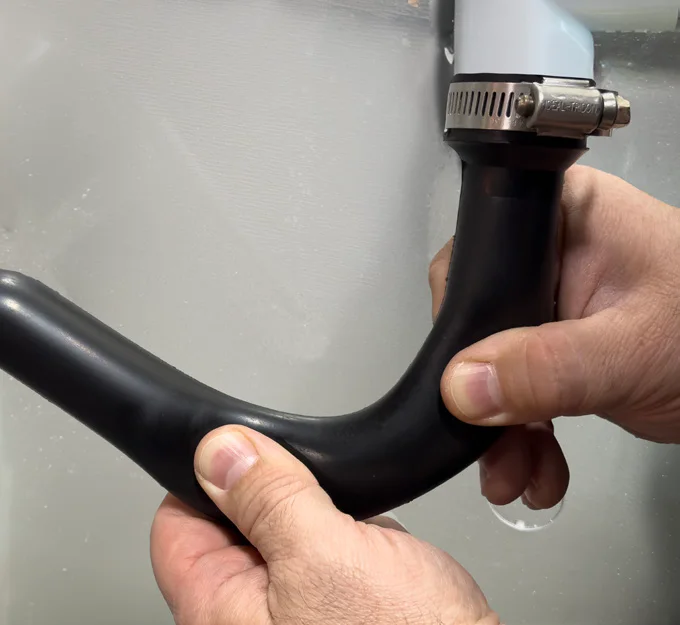
- Elastomeric PVC body
- Stainless steel clamps
- Made in USA
No primer or cement. The system goes back in service as soon as it’s clamped and primed.
The flexible body works into low-clearance attic units, tight closets and over a secondary pan.
No solvent odor left in the home and nothing to wipe off a finished floor.

¾″ Flexible Condensate P-Trap for HVAC Systems and Air Conditioners
Pipe or hub, end by end. Each end has a bushing. Leave it in to fit ¾″ PVC pipe, or take it out to fit a ¾″ hub.
- HVAC and air conditioning condensate lines
- Condensate drain lines
- Furnace condensate drainage
- Repair and replacement
- Residential and light commercial
- Made in USA
How to install
 Dry fitHold the new trap up to the existing line to check the fit. Mark lines on the pipe matching both ends of the new trap.
 Mark the cutMeasure ¾″ down from each dry fit mark and make a second mark. This is where you cut.
 Power offSwitch off power at the HVAC unit or at the circuit breaker.
 CutUse a PVC pipe cutter or hand saw to cut on the second mark at each end. Remove the old trap.
 DeburrUse a utility knife or deburring tool to scrape away plastic fragments and burrs.
 Loosen and set bushingsLoosen the screw on each clamp. Remove the included bushing if you’re installing over a hub.
 InstallSlide each end of the trap over its pipe or hub. Hand tighten each clamp with a nut driver or screwdriver.
 PrimePour 3 to 6 ounces of tap water directly into the line above the trap.
 Power onTurn the power back on and check for leaks.
Tools: tape measure, marker, PVC pipe cutter or hand saw, utility knife or deburring tool, and a nut driver or screwdriver.
Specifications
| Part | CT-075 ¾″ Flexible Condensate P-Trap for HVAC Systems and Air Conditioners |
| Fits | ¾″ PVC pipe (bushing in) or ¾″ hub (bushing out), at each end |
| Material | Elastomeric polyvinyl chloride |
| Clamps | Stainless steel |
| Temperature | -30°F minimum; 140°F maximum (intermittent) |
| Size | 1.30″ x 5.00″ x 8.12″ |
| Use | Drain, waste and vent only |
| Case quantity | 10 |
| Made in | USA |
Common questions
Will it fit my condensate line?
Each end fits ¾″ PVC pipe with its bushing in, or a ¾″ hub with the bushing out, so one end can go on a hub and the other on pipe. Not sure what you have? Reach out.
How do I clear a clog?
Squeeze the body by hand to break sediment loose. If that isn’t enough, back off the clamps with a nut driver, pull the trap out whole, clean it and reinstall it on the same connections. Then prime it again, the same way you did when you installed it.
Do I need to prime it?
Yes. After you install it, pour 3 to 6 ounces of tap water into the line above the trap. The water seal keeps the system’s fan from moving air through the drain, so condensate can drain out of the pan.
Do I need glue or primer?
No. The trap clamps on with stainless steel clamps, so there’s nothing to brush on and no cure time.
Can I use it on a furnace?
Yes. It’s made for HVAC, air conditioner and furnace condensate drain lines in residential and light commercial systems.
What temperatures can it handle?
Down to -30°F, and up to 140°F for short periods.
Documents
The sell sheet in English and French, and the step by step installation instructions.


