

By Fernco Traveller
Even on vacation, you cannot completely turn off the part of your brain that notices how things are connected.
Last week, I was at a water park with my family. Somewhere between the wave pool and the lazy river, I found myself standing beneath one of the large slides, studying the drain piping overhead.
Occupational hazard.
What caught my attention was a side-by-side comparison you could not easily stage. Connected to the slide’s drain fittings were three Fernco couplings: two standard flexible couplings and one Strong Back RC.
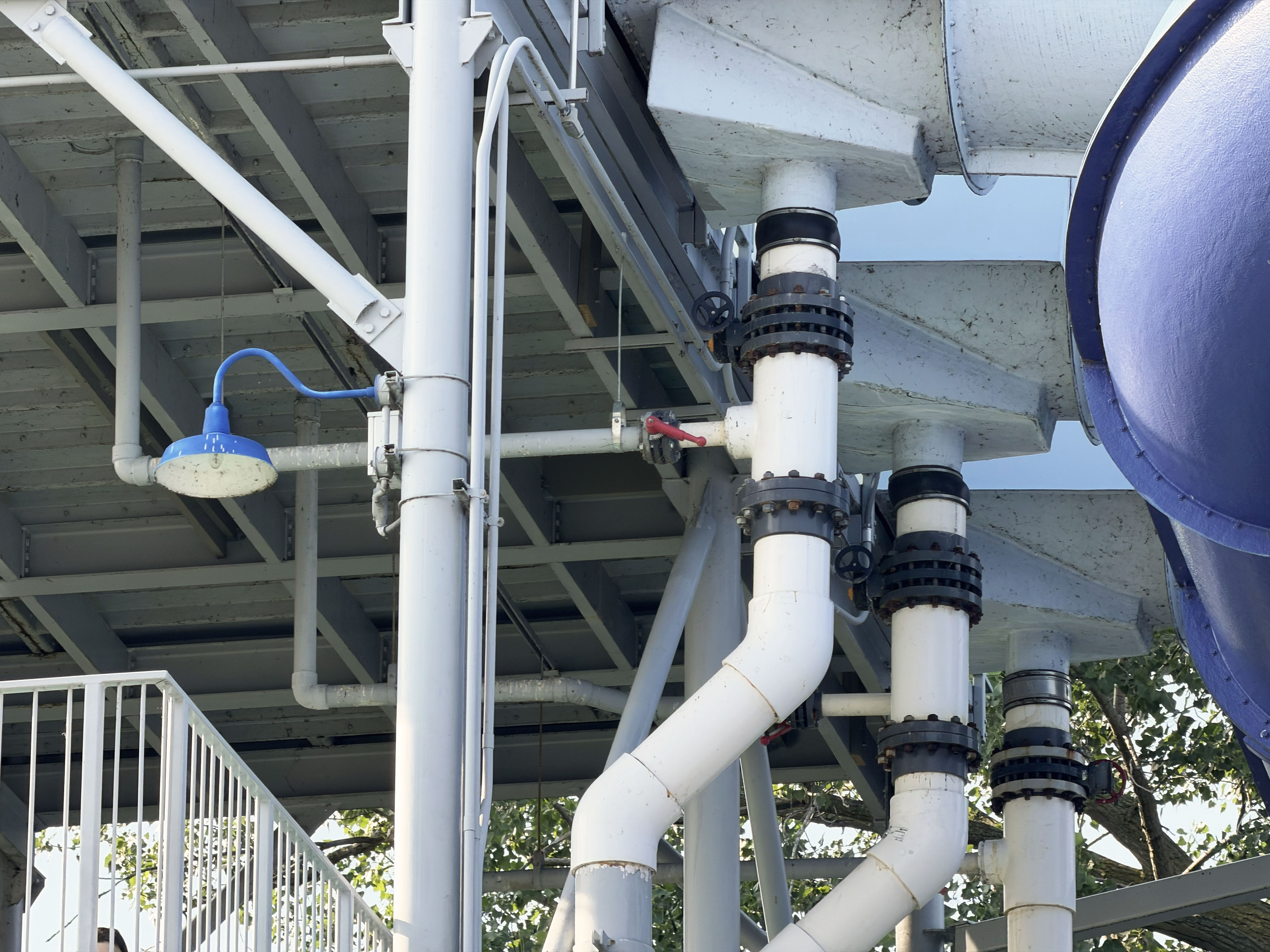
The slide’s drain piping: standard flexible couplings and a Strong Back RC working side by side.
The standard couplings showed visible deflection. The sleeves appeared to be flexing, and portions of the piping were sitting slightly off-axis.
The Strong Back RC appeared to be maintaining a straighter, more aligned connection.
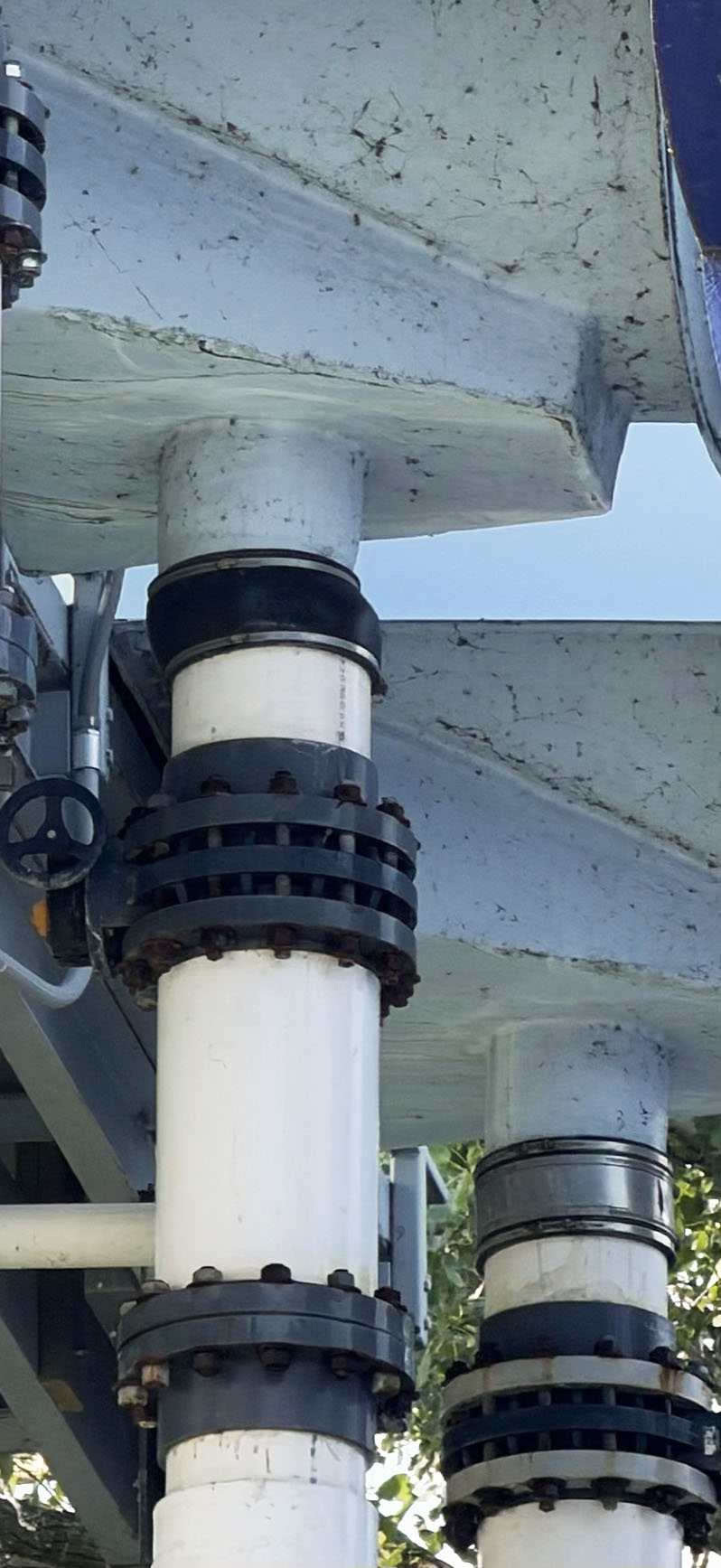
Close-up: the standard coupling (left) and the Strong Back RC (right).
Let’s Be Fair to the Standard Coupling
Before anyone reads this as criticism of standard Fernco flexible couplings, let me be clear: it is not. There are also important limitations to what can be concluded from a visual observation. I do not know when the couplings were installed, whether they were installed at the same time, or what the original alignment and support conditions looked like. It is possible that the Strong Back RC was added later to replace a previous connection. It is also possible that differences in pipe support, loading or installation contributed to what I saw. These photos are not a controlled test or a formal inspection. They are simply a real-world example of how different coupling designs may respond when a joint is exposed to movement or sustained side load. Standard Fernco flexible couplings have been an industry go-to for more than four decades. They conform to ASTM C1173, ASTM D5926 and CSA B602 and provide a dependable, leak-resistant connection across a wide variety of pipe materials and sizes.
There is a reason nearly every truck, shop and supply-house counter in America has a few on hand. When the application is right, they offer an outstanding combination of speed, versatility and value. The photos do not show a bad product. They show why selecting the right coupling for the application matters.
What a Standard Flexible Coupling Is Built to Do
A standard flexible coupling uses an elastomeric PVC sleeve and stainless steel clamps to create a secure connection between pipe ends. Its flexibility is one of its greatest advantages. It can absorb vibration, accommodate minor movement, help manage slight misalignment and make transitions between different pipe materials fast and dependable. In a properly bedded underground line or a properly supported drain run, that flexibility works in the installer’s favor. However, flexible materials also have practical limits. When an unshielded coupling is exposed to sustained shear or side loading, the sleeve may deflect. Those loads can result from soil settlement, inadequate bedding, poor backfill, heavy external loads or movement within the piping system. Over time, the joint may begin to sag or shift out of alignment even if the coupling continues to maintain its seal.
What the Strong Back RC Adds
The Strong Back RC begins with a dependable elastomeric seal and adds reinforcement designed to resist shear and help maintain pipe alignment.
Its construction includes:
- A heavy-duty .012-inch, or 12-mil, 300-series stainless steel shear ring that surrounds the coupling and helps distribute shear forces.
- A molded-in bushing designed to help keep unlike pipe ends aligned through the transition.
In Fernco shear-resistance testing performed in accordance with ASTM C1173, a load of 50 pounds per nominal inch of pipe diameter is applied to the connection. The result illustrates the difference in design. An unshielded flexible coupling is more likely to deflect under the applied load, while the Strong Back RC is designed to help keep the pipe ends aligned. It uses the same basic principle of a flexible seal, but adds a much stronger backbone.
Standard Flexible Coupling vs. Strong Back RC
| Standard Flexible Coupling | Strong Back RC |
|---|---|
|
|
Knowing Where the Line Is
The real takeaway is not that one coupling is always better than the other. It is that selecting the correct coupling for the application can help prevent movement, misalignment and future repairs.
Reach for a standard flexible coupling when:
- The pipe is properly supported on both sides of the joint.
- Bedding, hangers or other supports carry the weight of the piping.
- The connection is expected to experience only minor movement or vibration.
- Flexibility, speed and value are the primary considerations.
That describes a large percentage of drain, waste and sewer connections, which is why the standard coupling has earned its place in the industry for more than 50 years.
Consider stepping up to a Strong Back RC when:
- The joint may experience increased shear or side loading.
- Soil conditions are unstable or prone to settlement.
- Backfill or original bedding conditions cannot be confirmed.
- The connection is located beneath traffic or heavy earth loads.
- Different pipe materials must remain properly aligned.
- A repair or transition requires additional reinforcement.
Proper pipe support, bedding and installation practices are always essential. A reinforced coupling should not be treated as a substitute for meeting those requirements.
However, when the application calls for greater shear resistance, the additional upfront cost of a Strong Back RC can be small compared with the labor and disruption of returning to repair the same joint twice.
The Bottom Line
What I saw at the water park did not necessarily indicate a failed coupling or an unsafe installation.
It did provide a useful visual example of the difference between an unshielded flexible coupling and a coupling specifically reinforced to resist shear and maintain alignment.
Both products belong in the lineup. Both are code approved. Both are made in the USA.
The skill is not simply choosing one over the other. It is understanding the loads, support conditions and movement the joint may experience, and then selecting the coupling designed for those conditions.
Get that decision right, and either coupling can provide years of dependable service.
And if you ever want to see a real-world coupling comparison, remember to look up the next time you are waiting in line for a water slide.
Note: These observations are based solely on the visible condition of the piping and couplings. Installation history, support conditions and maintenance records were not available.
Learn more about Standard Flexible Couplings and Strong Back RC Couplings.